30 December 2025

When the system lives in you

This was going to be a different type of post - a show & tell of spreadsheets I've made over the years to optimize cognitive load out of my life. While writing the draft, I realized I hadn't actually used the spreadsheets in a while, yet the load hadn't come back. I figured out that while I'd used tech to save time (it did), the more I used it, the more I built muscle memory as I understood myself better, and the less I needed it in the end. I had unconsciously built rituals around the very tasks I was trying to offload. 

Exhibit A: Horowitz, the spreadsheet that picked out my clothes 
I used to hate getting dressed in the morning - I didn't know what my style was (specifically in a professional setting), and like most people always felt like I had nothing to wear. I tried to fix this with a spreadsheet, as one does - I built a categorized clothing inventory, threw it into a Google sheet, and added a randomizer formula to assemble outfits that I'd then copy-paste into a weekly plan. It's not a smart formula, so I'd regularly override silhouettes or combinations that didn't work. But it did the job. 

Then came ChatGPT: I gave it a target style, my inventory, and every Sunday would share the weather forecast and any after-work plans to get a detailed weekly wardrobe with notes. I loved this for a while. But over time I noticed I was using the GPT stylist less. Outfit planning was not scope creeping back into my mornings, though: I was getting dressed without thinking about it. 

Exhibit B: The meal planning sheet and GPT as Dietician
I enjoyed meal planning, until I didn't: it took so long each week. I tried optimizing by doing a similar thing as with Horowitz: `Veggie Backend` holds everything that grows in my zone, by seasonal month. The Home tab displays what's in season now; has sections for what to use up, buy, and eat for each meal; and another randomizer shows me options for quick meals, a recipe book to revisit, or snacks if I need help with ideas.

I had to go on a complicated diet this year due to health issues: it was impossible to keep track of the seemingly random combination of foods I could and couldn't eat, and the sheet became unusable. I had to switch to specialized apps and GPT to cross-check foods constantly. Over a few weeks though, I'd built a mental set of trusted ingredient LEGO blocks to combine into dozens of meals, and eventually shed the training wheels to eat intuitively without throwing my health upside down. What started with explicit rules were becoming internalized patterns with repeat use and some reflection.

So what was going on here? I started reading various theories and frameworks in education - how people learn and develop skills, specifically - and the concept that stuck out was the Zone of Proximal Development.


Each concentric circle is the learner's ability to do a task; Psychologist Lev Vygotsky proposed that the learner "gets involved in a dialogue with the 'more knowledgeable other' and gradually, through social interaction and sense-making, develops the ability to solve problems independently and do certain tasks without help." The more knowledgeable other is usually a teacher, and their support can sometimes be referred to as scaffolding: like on a building, the outer layers of support are removed as the learner is able to perform the task on their own.

For me, the spreadsheet formulas (and then LLMs) were my own scaffolding - a constant dialogue between the tech and me - for performing repeat tasks that once ate up my time, drained me of energy, and sometimes had high stakes (like with the diet), which dialed up the cognitive fatigue even more. 

The repeat use of these digital tools saved time, sure, but the real impact came from their repeat use helping me learn my own patterns. Once I had grokked those patterns, I barely needed the tools at all - now I walk straight into my closet each morning, and sit down to write out my planned meals straight in my planner for the week. The ghost and the shell became fused in a cybernetic feedback loop of intuitive, natural tasks that once felt clunky and daunting. The real sign that my "systems" worked wasn't the efficiency, but how unremarkable these habits became once they no longer had to live outside of me.

21 October 2025

Coffee logging

I’ve been using the Kokuyo Jibun Techo planner system for five+ years, and most of that time never knew what to do with one of the spreads towards the front - two tiny rectangles for every single day of the year. Last year, I started logging my coffee consumption - one color per brew type:


It’s been nice to look back on each month and see patterns; things like time of year (more cold brew in summers), what I was doing (a work trip with drip at the hotel and espresso at the office, rinse and repeat), or my general routines (Moka Americanos on weekends). Little caffeinated DNA bands.

12 September 2013

Mike Daisey on carrying a chopstick around

Just read an interview with Mike Daisey in this week's New York Magazine; this part was my favorite:

He dabs his sweaty forehead, just like onstage, and pulls out what I at first take to be a pencil. But it turns out to be, upon inspection, a lacquered chopstick. He looks embarrassed when I ask him about it. "Man, I'm supposed to leave it in my pocket during interviews," he says. "I actually have a little jar of them. When I was a kid, I would play with a pencil all the time. Then this will sound really weird. I transitioned from pencils to chopsticks, because when I would have a pencil, I would like to use unsharpened pencils, because I would stab myself in the hand with them, and they don't balance right. After I wrote my first book, people would come up to me and would be like, 'So, you're a writer. You aren't going to write very much with that unsharpened pencil.' This doesn't sound like a joke a lot of people would make. Crazy numbers of people would make this joke. Every fucking day. I literally trained myself to switch to chopsticks from pencils because it's weirder. No one says fucking anything, or they don't notice it. They're like, 'Is that a baton? What the hell is going on over there?'"

08 July 2013

Mapping the brain

I got an email a couple of months ago from a girl called Allison Morris, who stumbled upon my post on muscle memory and piano playing. She recently worked on an interactive piece that teaches you about the different parts and functions of the brain in a quick and fun infographic:

I spent a few minutes clicking around and the sound bites are really fun. My favorites: That there is activity in the occipital lobe (which handles vision) when blind people read braille, even though they aren't visually reading. That the hippocampus (the part of your brain that controls memory) is bigger than average in a London taxi driver's brain, "because complex spatial information is stored here (such as a spiderweb of roads)." There's also really interesting stuff about what happens in your brain when you hear voices as a schizophrenic, how the brains of musicians and multilingual people are different, etc. Take a few and click around. Super fun.

Also, if you haven't, click through to read about the BRAIN initiative - a research initiative to map the activity of every single neuron in the brain ("almost 100 billion neurons making trillions of connections") o_o

06 June 2013

SoHo buildings' economic domino effect

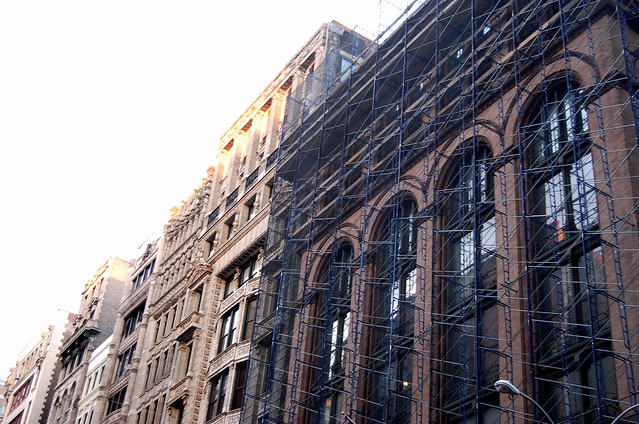
I just read a super interesting article on Urban Omnibus -- Living Lofts: The Evolution of the Cast Iron District. This is one of those articles that I want to copy and paste in its entirety. Briefly: It talks about how SoHo's buildings have been used over time, and what effects they have had on the communities, laws, and overall transformation of the neighborhood throughout history.

Doesn't show as well in this photo.

This is one of my favorite parts, on artist lofts in the 1960s:

Many lofts remained empty for quite some time until artists began moving in to what had become a desolate, dirty, and dangerous area. These new residents lived illegally in raw industrial lofts they made habitable by installing bathrooms and taping plastic sheets over the windows to keep out the cold. Living conditions were often uncomfortable at best. The area was empty at night, the crime rate was high, and the streets were filthy, as there was no regular trash pickup. There were no schools or clinics, and no grocery stores or restaurants, save for a couple of diners open only for breakfast and lunch to serve the factory workers. It was a kind of no-man’s-land that even taxi drivers had trouble navigating. On the other hand, the small population and isolation from infrastructure and resources created a tight-knit community of residents. Everyone knew each other by name and looked after one other. Because there were so few public services, the community provided for themselves, opening restaurants for locals and forming community playgroups where neighbors often paid for goods and services with their time and involvement instead of cash.

After 1971, it was deemed legal for artists to live in the smaller lofts in SoHo (in two specific zones), which brought up an interesting set of criteria on what makes one an artist (awesome when law and philosophy meet, no?). It sounds like artists had to fill these out when applying to live in the neighborhood. When an artist applied to live in SoHo, their "commitment to [their] creative work" would be assessed.

1. A description of the artist’s work.

2. A description of the artist’s need for space.

3. A biographical sketch including data the artist feels is pertinent; education, professional training, public exhibitions or performances, reviews, or grants.

4. Other data. If the artist does not feel properly represented by 1, 2, or 3, above, he can: a) present documentation of his work in the form of slides, photographs or other data which will back up his commitment and space needs—but not his aesthetics, or b) ask a few members of the Committee to visit his studio or working space to discuss his situation.

5. The names of two people who are familiar with the artist’s work and who can testify to his commitment and his need for loft space.

It doesn't sound like this law has formally disappeared: "Every non-artist who moves into SoHo today could theoretically be told to move out unless he or she can prove artistic legitimacy, but the probability of that aspect of the law being enforced is low."

There were tugs of war between artist tenants and landlords, and various social shifts that over a couple of decades have turned SoHo into what it is today. The article glosses over the minutiae of how these "economic and social" shifts happened, which I'd be really interested to read more about. This paragraph should feel more familiar to anybody who's been to the area recently:

The change in the socio-economic makeup of SoHo residents brought with it commercial development. Art galleries began to move out of the neighborhood in the 1980s and 1990s, mostly to Chelsea where rents were more reasonable, and were replaced by high-end boutiques, restaurants, bars, and nightclubs. Nightlife destinations brought unwelcome street noise, and the SoHo Alliance fought hard against the issuing of new liquor licenses.

So good. Heading over to the writer's more permanent home, SoHo Memory Project, to see if I can find out more.

02 May 2013

ChimeO'Clock

Sometimes it's ok to make an app that is a little piece of beautiful candy. From an email I wrote UC this month:

It's starting to get nice out.

You probably still want to make more of an effort to get up and walk around more during the day, right?

Do you like pretty things.

I've been using this app that does nothing other than chime every hour, half hour, or quarter hour.

It reminds me to get up, shake the zombie out and let my brain unravel.

(And if you've ever played Portal, you'll appreciate the Voice option).

[ChimeO'Clock]

26 February 2013

Four lexical gustatory examples

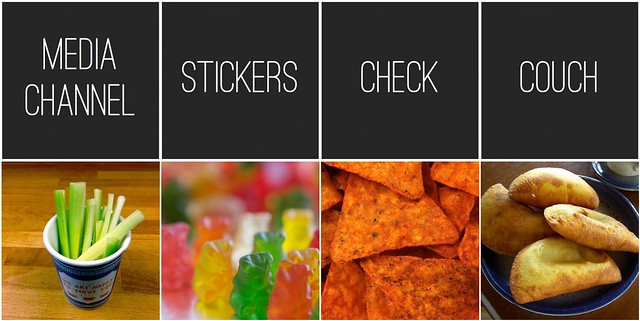
For anyone new to this blog or who doesn't know, I have two mild forms of synesthesia: sound color (I see colors when I hear certain sounds, notes or songs) and lexical gustatory (tasting certain things, or craving tastes, when I hear certain sounds or words) - I'm going to abbreviate this LG for now. The latter is much more fun, but as I said, they're both mild and don't surface that often. Well! Yesterday, I discovered a new LG synesthesia cue for me: the word "stickers" makes me taste and/or crave gummy candy. Neither the pearly kind nor the sour kind - the classic, transparent/jelly kind. I excitedly tweeted this, got into a mini conversation with Mikey Il about it, and then realized that sharing four of my lexical gustatory cues with you guys might be fun.

Lexical gustatory synesthesia

Media channel is celery. This one came up between 2 and 5 years ago. I'm thinking it was when I was still at Naked NY, since the nature of our work had us talking about media channels all the time. This is a very refreshing, crunchy pair of words for me.

Stickers is gummy candy. I have of course heard the word before, but for some reason when I read it out loud from an email yesterday, I flung up in my seat, ran to the kitchen, and ate a bunch of gummy Vitamin Cs and ginger chews. Every time I've uttered or heard the word since (I've been saying it a lot), I have the same sensation, taste, or craving.

Check is Doritos. Well, sort of. This one is fairly old, and I first remember it happening in middle school some time. It's not only the word check, but most words with a hard "ch" sound, and an "E" somewhere in the word. But the E has to be pronounceable. It can either be a short E, like in checkers, check, or Chester, or a long E, like in cheese, cheat, or cheek. Soft "ch" words don't count ("chenille" doesn't do anything for me in an LG way, for example, other than picturing a pile of cooked, blue-tinted glass noodles, but I'm not sure what that means either!? That literally just happened.).

Couch is my first LG cue ever, when I was about five years old. It happened while listening to a Teddy Ruxpin tape. There was one story where he and Grubby, and maybe some other characters were exploring the inside of a couch, and it was this big adventure. Every time Teddy Ruxpin said couch, I got this desire to eat something. But I couldn't figure out what, for years and years. Almost 20 years later, on the way to White Plains for a client meeting, a team I was on stopped to pick up lunch. The second I bit into my first-ever potato empanada, I yelled out loud, "OH MY GOD, IT'S COUCH!" I didn't realize this was due to a form of synesthesia yet, so it was a little awkward explaining what the hell I meant by my outburst.

Fun? Should I do more of these? Do any of you guys have any forms of synesthesia? Please tell me. I've never met or spoken to one before.

Related Posts Plugin for WordPress, Blogger...