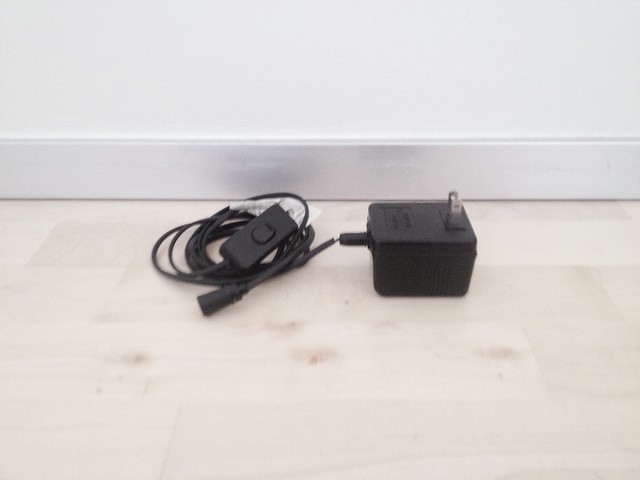
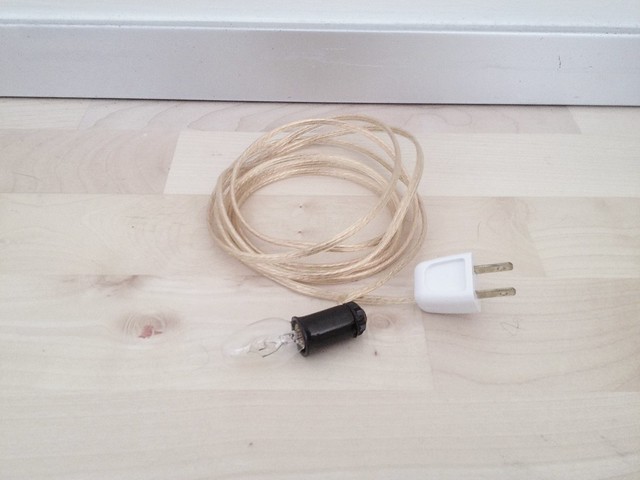
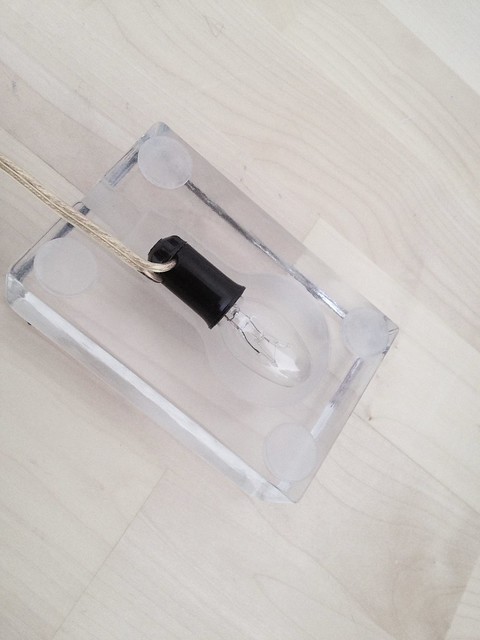
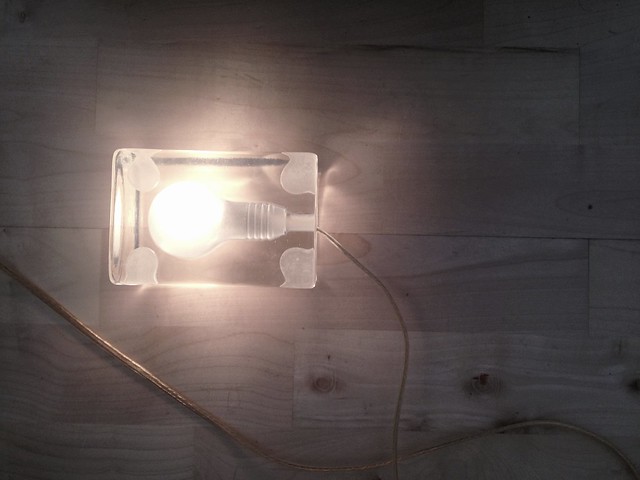
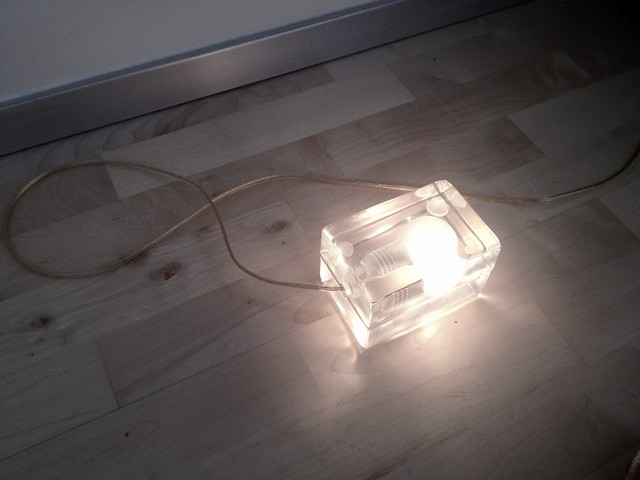
I got one of these Design House Stockholm block lamps four years ago; for three of those years, it sat in pieces in a corner. Once the bulb burned out (or I knocked the filament loose, oops), I could not for the life of me find a replacement – the website suggested a 25W candelabra, but none that I could find would either a) fit into the glass encasement, or b) fit into the strangely small barrel of the cord. It befuddled associates across a few hardware stores.
Finally, we got fed up and decided to scrap the original cord entirely and build a new one.
We made this with a 7W candelabra bulb, seven feet of lamp wire, a two prong male plug, and a bulb barrel socket screw thingie. I also picked up a pack of vinyl bumpers (replacing the originals that had fallen off over time), to keep the glass from sliding around and chipping.
We're not quite done yet; right now you can only turn it on by plugging it into the wall. We bought one of those wheel click switch things to add, but further decisions will wait for another weekend. For now…
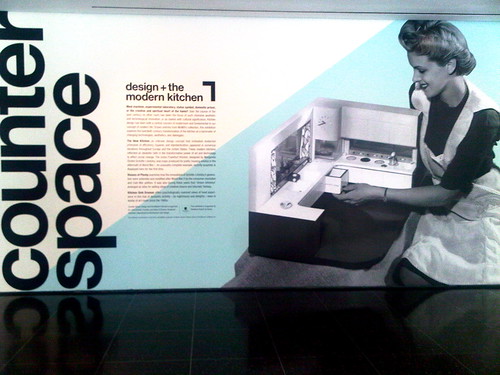
I took the day off today, and set out for the MoMA bright and early for some much-needed inspiration. I didn't know what I would find, really, as I haven't been great at reading my member emails. The most delightful surprise was an exhibit that's been around for around 4 months, called Counter Space: Design and the Modern Kitchen.
In their words:
Over the course of the past century no other room has been the focus of such intensive aesthetic and technological innovation, or as loaded with cultural significance. Kitchen design has been both a central concern of modernism and fundamental to our concept of modern life. Drawn entirely from MoMA’s collection, this exhibition explores the twentieth-century transformation of the kitchen as a barometer of changing technologies, aesthetics, and ideologies.
I read this description after walking around for a bit, and found that I'm definitely not alone in my fascination with kitchens. I don't do a ton of cooking, though I love the idea of it and always plan to do more. I always love kitchen-related gifts the most (you should have seen me when I opened a wine foil cutter at Christmas), love kitchen-related photography, and always daydream when I apartment-hunt that I'll find one with a window to filter Saturday morning sunlight in as I make tea. Not sure why, the way I frame kitchens in my head... it's almost like peering into a dollhouse.
Anyway, the exhibit. What a delight. There were rotating models of 70s modular kitchens, movie stills from the 50s, a plastic food collection from Japan, old appliances, historical photographs and ads (I noticed one on loan from DDB's archive, how cool is that), kitchen efficiency books, and a ton of stuff about the "Frankfurt Kitchen," which was part of a movement in 20s Germany relating to egalitarianism. Here are some pictures I took with my phone (why I didn't bring my camera today, I have no idea) --
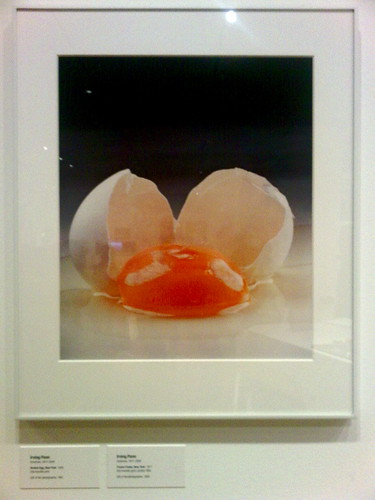
This is an Irving Penn photo. I recently found out that he shot the first Clinique print ads, in the 1960s. Cool, no?
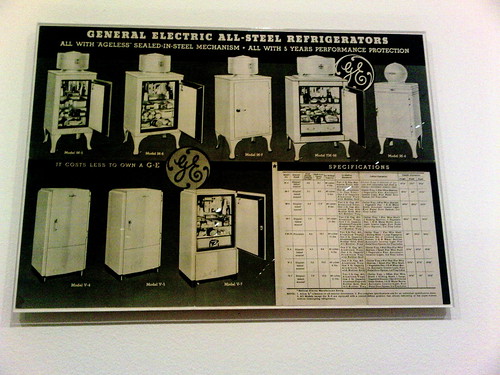
I have worked with GE for quite some time, so this was far out and awesome to see.
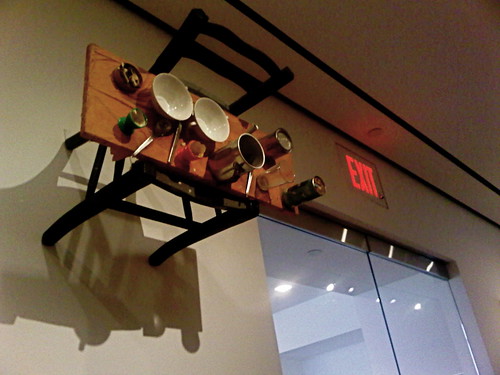
This was the first thing I saw when I walked in. Looking closely revealed old egg shells in the egg cups and cigarettes in the ashtray.
I also saw this thing – and I'm really annoyed that I didn't take a picture of it – that looked like a small bicycle wheel. I knew was it was before I even read the plaque: it was a cake slicer. My head blew up a little, because I've throughout my life always remembered this Betty Boop cartoon that features her inventor-friend, Grampy, opening an umbrella skeleton and pushing it down onto a cake to slice it instantly. I always thought that was so cool, and I can't believe it's actually a thing that existed once. Why don't I ever see those now? It seems like the most efficient way to do things, ever.
Anyway. I recommend paying this exhibit a visit if you're in the area and this sounds remotely interesting to you. Here is the exhibit site (there is a blog, too!). Also a few more pictures with commentary in this Flickr set.
Part of my being unimpressed with iWork.com so far is that it seems I can't work on anything else while one file is being uploaded (which so far has taken about an hour and is not finished yet). So you get to look at some pictures. There is not too much deep thought to this post; I just was sitting on my couch last week, staring at an album playing on my record player. I thought, "So, this massive circle spins, and a whole song takes up very little space in this format. How did they ever think of doing it this way?"
And then I realized that over time (and up until digital files), everything that played music has been based on rotation. Duh. I know, so obvious. But it was fun to keep thinking of examples.
Phonograph
Organ grinder
Nickelodeon
Music box
Casette tape
CD
Any more that I'm missing? I wonder if Steve Jobs got the click wheel idea from this.
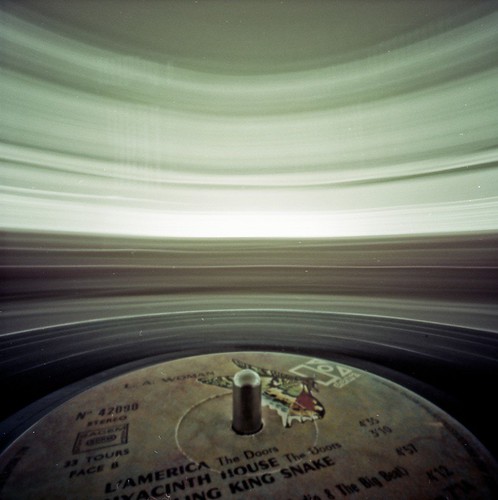
Motivational credit: Photojojo linked to this picture of a pinhole camera sitting on a record while the turn table was spinning:
It inspired me to get this thought down before I forgot about it again. Cool, no?
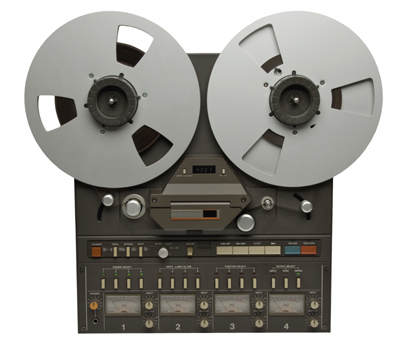
EDIT 7 Sept | Zachary gave me two that I missed! Reel to reel and 8 track.
The Korea Institute of Design Promotion, Design Seoul Headquarters of Seoul Metropolitan Government, and HyundaiCard have helped bring a new collection to the MoMA store. As the screen shot says, a collection of awesome stuff from young Korean designers. The stuff ranges from cute to strange, amusing and brilliantly practical. Check out the full collection here.
There is a very interesting and insightful mini-interview with Philippe Starck in the September 2008 issue of WIRED Magazine. It starts out with the inspiration for his latest chair, Mr. Impossible, and goes into "green" philosophy (he's actually smart about it too).
What was the inspiration for Mr. Impossible? The speed of evolution of our civilization and the dematerialization that rules all our production. Take the computer: It was the size of a room, then a briefcase. Now it's a credit card. You cannot dematerialize a chair completely because you must continue to st on it. But you can make it invisible. That's why I made the Mr. Impossible with a double shell – it's basically made of air.
Recently, you have begun to look at the environmental impact of your designs. How does a plastic chair fit in? The stupidity of the ecological movement is that people kill trees for wood. It's ridiculous. The best ecological strategy is to make products of a very high creative quality, so you can keep them for three generations. I prefer to make a very good chair in the best polycarbonate than make any shit in wood that will be in the trash one year later.
Why not use recycled plastic? It's a little joke of a material. You can do almost nothing with it. And I also refuse bioplastic, which comes from something that people can eat. Scientists agree that we have a real food problem, a famine approaching. It's a crime against humanity to take something you can eat and make a chair – or use it as gas for your SUV.
How do you reconcile those principles with your position as creative director for Virgin Galactic? Every project should fit the big image of evolution. You can consider Virgin Galactic as something only for rich people, but you can also analyze the incredible help that it will give us. The exploration of space is a vital part of our evolution. We don't have any future if we don't go into space. This world will explode in 4 billion years. We have time, but not so much.
Some exciting news from my friend Ed in Hong Kong (this Ed). The first product coming out of his side project, SCHOOL is out - the Unofficial Olympic Shirt. As he puts it:
A t-shirt that really embraces the value of the Olympics - UNITY. We haven't paid multi-million dollar sponsorship deal so you won't see rings nor mascots on any of our shirts. Instead we've woven all participating nations into one piece of fabric. 888 of these limited edition shirts were lovingly made with the finest cotton to commemorate the event opening on 08.08.08.
The design is really great: it strings all of the nations into a double helix-style design (a further symbol of us all coming together).
The shirt comes in marshmallow white, cotton candy blue and cotton candy pink.
You can get it for $45, free worldwide shipping, no tax. Pretty amazing, I love the colors, meaning and can't wait for mine. Great stuff, Ed!
I've written about 25 Project quite recently... just a small update. This month's theme was requests, and my request was made! I said "shadows and sunlight" or something similar... this is what Michelle made (+ caption)
Shadows and light. I realized that the request was actually "shadows and sunlight" when I was about 95% done with the drawing - sorry!
Hooray! It's lovely. I love the little teeth monster looking guys.
I've been reading 25 Project for a few months and it's quickly becoming one of my favorite blogs (read: when I am drowning in work, one of the only ones I read). Beginning on her 25th birthday (in November 2007), Michelle of Crowded Teeth ("online store /clothing line") decided to create one art project a day for a year. Each month has a different theme, and the end result will be 25 hand-made books and an art show. Here are my favorites from each month /theme:
November : Patterns
December : Characters
January : Fonts & Typography
February : Scenes from daily life
March : Photography
Adorable and imaginative, right? 25 Project is guaranteed to make you smile.
This is part 2 in a mini blog series: Smaller Versions Of What I Had Planned. I can't let all of the "to blog" ideas that I had floating around in my head disappear, even if they may be irrelevant by now. Here's a brief rundown of stuff I saw & went to that I had to go back six pages in my Flickr stream to reference.
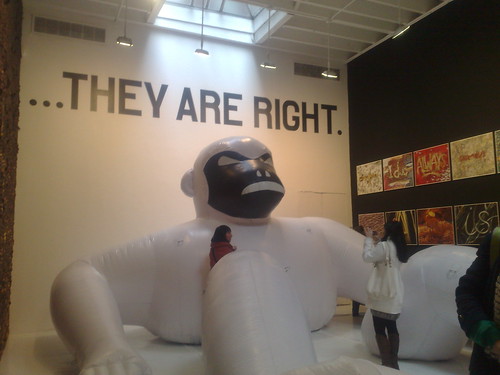
This was the perfect followup to Design and the Elastic Mind. I went straight from the MoMA to Deitch Projects for the final day of this exhibit. It coincided with Sagmeister's book release, which could be purchased at the gallery. This one was really engaging and visually stimulating, which I definitely needed at the time.
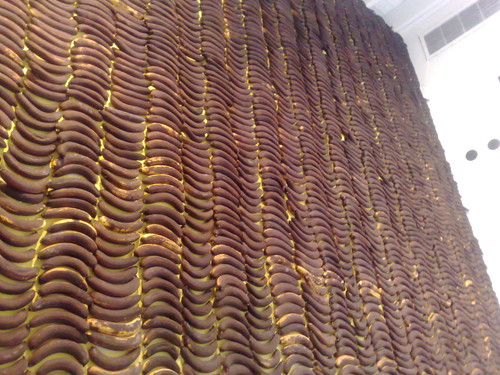
The second I walked in, I thought of Tahiti, which I couldn't really explain since I have never been there (all I know about it are Gaugin's paintings). I realized what it was when I walked to the back room though: a wall completely wallpapered with bananas.
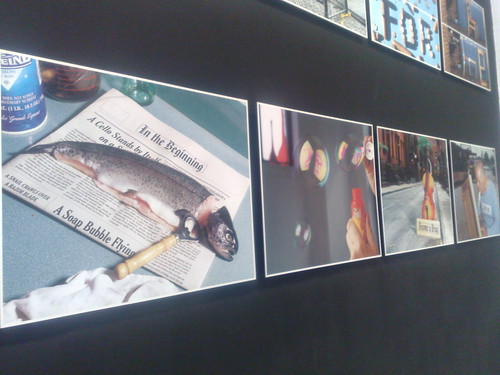
Some of the lessons that we saw through his art (he had a series of photographs lined up, each one with a different word on it):
- Everything I do always comes back to me - Starting a charity is surprisingly easy - Having guts always works out for me - Drugs are fun in the beginning but become a drag later on
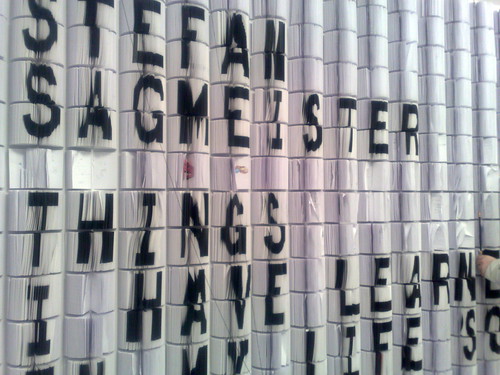
Here was a cool part: dozens of little sketchbooks with hanging pencils. I drew a seahorse in one.
Sadly, I can't recommend this exhibit because it's over. You can buy the book, though.
I have been going absolutely insane lately; the past three weekends for me have consisted of work (both Saturday and Sunday), among other things. While this isn't terrible (I deal very well with things when I have the option to take a nap in the middle of the day if I like), I have a note on my computer with a mushrooming list of seven things to write about. It includes three exhibits (one of them probably irrelevant to talk about by now (the Stefan Sagmeister one @ Deitch Projects that is now over)), a couple of cool things I have seen around, etc. I'll get to it. I think.
So, apologies. For now though, here is something: my friend Ryan started a blog. Ryan is a friend of mine from grad school, and I've always been able to turn to him for snippets on everything cool (he was like my personal Wooster Collective-meets-NOTCOT). You can imagine how excited I was to hear the news.
Well, Ryan didn't disappoint. Less than a week after starting beenkbeenk, he uploads one of his latest videos called Dream.
For being his first venture into After Effects, I'd say: pretty damn good, kind sir. Thanks for making me smile today.