Showing posts with label memory. Show all posts

14 September 2011

On muscle memory and piano playing

I took a trip to visit my parents a few weeks ago, and they surprised me by having my upright piano tuned. Halfway through a 30-minute stretch of playing bits of assorted songs, I realized something: I was on autopilot. I was daydreaming, staring off into space, and playing Yann Tiersen.

Now, this isn't necessarily a strange thing, because I've been playing for a long time and don't always have to pay conscious attention to every single note. But usually when I play Tiersen's work, I at least have to be partially thinking about what bit of the song comes next. On my upright, I didn't at all.

The reason I had such a hard time with this was: I didn't learn his music on my upright. I learned it on my digital piano. Shouldn't any song come more easily to me on the piano on which it was learned? This seemed like some sort of bonkers anti-state-dependent memory at work. I mulled the topic of muscle memory around in my head for a while, and finally dug into Wikipedia a little today to help with some rough thinking:
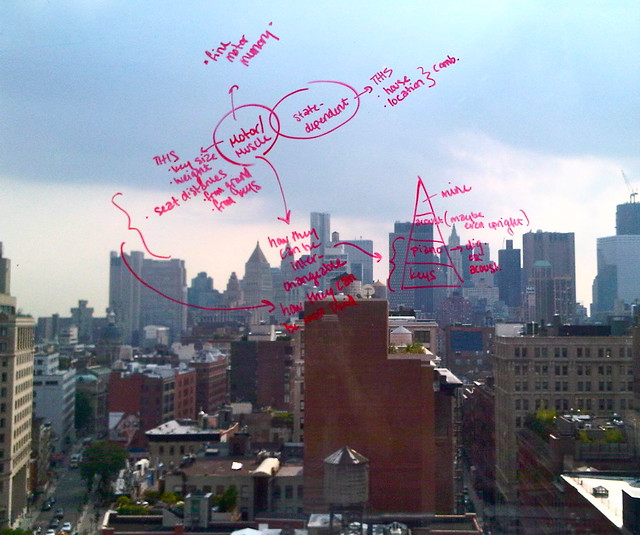
Some thinking on music memory.

I realize that there is a lot of research already done around fine motor memory, the psychology of music performance, etc. But this is where my thinking-out-loud-for-fun brain took me.


As I said, my mind went to muscle memory first. At the base level, once someone has played the piano enough, they can play any piano. Quite literally "Like riding a bike." But something I recently read in Piano: The Making of a Steinway Concert Grand – that all pianos have their own personalities, tones, and feels – had me thinking about particulars. There's a reason why, even though I know how to ride a bike, I've always nearly broken my neck when attempting to ride bikes with bullhorn handlebars, yet felt like I could ride the ones with riser handlebars in my sleep. More than just muscle memory for the act of piano-playing, it was THIS piano (my upright) that I spent the most time with; THOSE keys, with their particular width, spacing and weight; THAT bench's distance from the ground and piano itself.

The other circle in that chart, state-dependent memory, represents that piano's environment. It's in the same place in my parents' house that it's always been in – off of the kitchen and under the Verona painting. Also, I'm much more used to the feel of the house I grew up in than I am in an apartment I've been renting for just 2 years (on top of that: my digital piano is in its 5th environment, or apartment, by this point).

So, muscle memory is how pianos can be played interchangeably. And the particulars of muscle memory with a side of state-dependent memory – that piano in that position of that house – is what made my playing the most fluid. Here's another way of looking at it:


I can play almost any instrument with a basic piano keyboard setup – from an accordion to a Schroder-style toy piano. But I'm not very good. I'm better with a proper piano – either acoustic or digital. By "proper," I mean all 88 keys that are weighted. Next comes any acoustic piano. As awesome as brands like Casio and KORG have gotten at simulating acoustic pianos with their digital versions (I have a Casio, and I love it), there is just no substitution for the feeling of hitting a key that subsequently makes a tiny hammer hit a string. And finally, my most familiar piano. This is why I think it doesn't matter at this point which piano I actually learned a song on: I'll always be better at it on that one upright.

For your supplementary fun:
Muscle memory (Wikipedia)
State-dependent learning (Wikipedia)
A page on sight-reading and memory (from The science & psychology of music performance)
My favorite Yann Tiersen-related video ever: Dave Thomas playing La Noyee on accordion

19 May 2009

More cognitive easter eggs

This week's NY Magazine is making me bounce all over the streets. And I'm not even halfway through it yet! The part that I want to particularly share is in the main feature, In Defense of Distraction. It talks about the dozens of things that divide our attention these days; whether or not they are terrible for us; whether or not the great minds of history would have been able to accomplish what they did in today's world ("If Einstein were alive today, [world multitasking expert David Meyer] says, he’d probably be forced to multitask so relentlessly in the Swiss patent office that he’d never get a chance to work out the theory of relativity."); etc.

Here is a little portion from the last quarter of the piece:
...The most famous moment in all of Proust, the moment that launches the entire monumental project, is a moment of pure distraction: when the narrator, Marcel, eats a spoonful of tea-soaked madeleine and finds himself instantly transported back to the world of his childhood. Proust makes it clear that conscious focus could never have yielded such profound magic: Marcel has to abandon the constraints of what he calls “voluntary memory”—the kind of narrow, purpose-driven attention that Adderall, say, might have allowed him to harness—in order to get to the deeper truths available only by distraction. That famous cookie is a kind of hyperlink: a little blip that launches an associative cascade of a million other subjects. This sort of free-associative wandering is essential to the creative process; one moment of judicious unmindfulness can inspire thousands of hours of mindfulness.
If that isn't a lovelier and better thought-out articulation of cognitive easter eggs than I could ever write, I will mistake my wife for a hat. Isn't that nice? I loved reading Sam Anderson's take on things.

I recommend reading the entire article, actually. A lot of interesting pieces of history and research come into it, and as serious a consideration this whole thing is, Anderson balances it with a great amount of humor and optimism for our future. Also, he endorses reading about the Boston Molasses Disaster two or three times ("The world is a stranger place than we will ever know"), and I wholeheartedly agree! I wrote about it last June, check it out. It's the oddest historical disaster you'll read about all week, I bet.

08 May 2009

Memory and cognitive easter eggs

Last week, my friend Laura and I were talking about riding a bike. Mostly, the type of balance that it requires, and what our neighborhoods were like, growing-up (conducive to bike riding, too dangerous, close to school, etc.). All of a sudden, I remembered learning how to ride a bike.

Blue states win

I don't remember how old I was, but it was in Germany. I was visiting my grandparents for a couple of weeks, and someone lent me a kid's bike. The street that my Oma and Opa's house was on sloped upward, and ended at a little market. My father would walk to the end of the street with me, and I would glide down, all the way to the house. I did this dozens of times, slowly inching the training wheels up little by little. Eventually, I pedaled all the way down. I had a huge grin on my face, and I think my dad was laughing (which he does when he's really excited about something). It was a beautiful day, the sun reflected off of the green and yellow fence, there were bees on the cherries that had fallen from the trees. It's such a vivid memory, and I hadn't thought about it... probably since it happened.

It reminded me of something I read in WIRED a month or two ago. There is this article about a woman with a seemingly photographic memory that explains how our brains store memories vs. computers. The short of it: computers have a very organized way of storing information, and it's instantly accessible at all times. It looks something like this:


And the brain is really messy about this whole process, which resembles something like this:


Here is the article text:
On a computer, every single bit of information is stored at a specific location, from which it can always be retrieved. Human recall is hit or miss. Neuroscientific research tells us that our brains don't use a fixed-address system, and memories tend to overlap, combine, and disappear for reasons no one yet understands.

The one thing we do know is rather vague: Memories live in the hippocampus and the prefrontal cortex. After that, the entire question of how memory works is up for grabs. For example, where precisely in the hippocampus (or prefrontal cortex) is my memory of reading Kurt Vonnegut for the first time? If I try to summon that experience, I am likely to wind up with a blur—a half dozen indistinct recollections. And no brain-scan technology will help me bring it into better focus.
This makes human memory sound potentially a pain in the neck, but it's really kind of awesome. Yeah, I wish there were a way to bring up perfect memories that I haven't thought about in a while. But with this "imperfect" way of storing, the brain actually becomes an enabler of cognitive easter eggs. Throughout life, there are little land mines that will trigger pleasant memories without warning that for years had been tucked away somewhere unreachable. Can't wait for my next one.

On our way to Newport

What are some of your recently triggered memories that you had forgotten about for a long time? What triggered them?
Related Posts Plugin for WordPress, Blogger...