Showing posts with label technology. Show all posts

01 February 2026

Building a Metal Search Bar (1 of ?)

Metal Archives is like a wiki for heavy metal, and I use it for exactly one thing: looking up bands. I do this exclusively on my phone from either record shops or shows - the site isn't responsive, so I end up trying to tap on what feels like a 3 pixel high search box on the very top right of the screen.


A search bar for ants.

After struggling with this for years, I finally tried to fix it fore myself in the smallest way possible.

What I wanted

A page with only a giant search bar on it that I could use 1. on my phone; 2. from anywhere: it would query Metal Archives and return the band's subgenre(s) and location. That's it.

Fast forward through a couple hours with Claude Code. The project half failed: Metal Archives has no public API and sophisticated enough bot detection that blocked all my searches, leading me to hit a wall for the "from anywhere" part of my use case. 

What did work

I did get a proof of concept working on my WiFi, and set it up to run automatically and be accessible from my phone any time I'm at home for quick lookups. Along the way, I learned about everything from proxies and anti-bot systems to serverless functions and headless browsers. 

It works!
I also ended up finding an unofficial API (Metal Archives themselves don't have a public one), and reached out to Metal Archives to make sure they'd be okay with me using it for personal purposes. But if this is the end of it, I'm still happy I finally went for and built this: a small thing I've wanted to exist for years, and a satisfying use of a Saturday morning.

30 December 2025

When the system lives in you

This was going to be a different type of post - a show & tell of spreadsheets I've made over the years to optimize cognitive load out of my life. While writing the draft, I realized I hadn't actually used the spreadsheets in a while, yet the load hadn't come back. I figured out that while I'd used tech to save time (it did), the more I used it, the more I built muscle memory as I understood myself better, and the less I needed it in the end. I had unconsciously built rituals around the very tasks I was trying to offload. 

Exhibit A: Horowitz, the spreadsheet that picked out my clothes 
I used to hate getting dressed in the morning - I didn't know what my style was (specifically in a professional setting), and like most people always felt like I had nothing to wear. I tried to fix this with a spreadsheet, as one does - I built a categorized clothing inventory, threw it into a Google sheet, and added a randomizer formula to assemble outfits that I'd then copy-paste into a weekly plan. It's not a smart formula, so I'd regularly override silhouettes or combinations that didn't work. But it did the job. 

Then came ChatGPT: I gave it a target style, my inventory, and every Sunday would share the weather forecast and any after-work plans to get a detailed weekly wardrobe with notes. I loved this for a while. But over time I noticed I was using the GPT stylist less. Outfit planning was not scope creeping back into my mornings, though: I was getting dressed without thinking about it. 

Exhibit B: The meal planning sheet and GPT as Dietician
I enjoyed meal planning, until I didn't: it took so long each week. I tried optimizing by doing a similar thing as with Horowitz: `Veggie Backend` holds everything that grows in my zone, by seasonal month. The Home tab displays what's in season now; has sections for what to use up, buy, and eat for each meal; and another randomizer shows me options for quick meals, a recipe book to revisit, or snacks if I need help with ideas.

I had to go on a complicated diet this year due to health issues: it was impossible to keep track of the seemingly random combination of foods I could and couldn't eat, and the sheet became unusable. I had to switch to specialized apps and GPT to cross-check foods constantly. Over a few weeks though, I'd built a mental set of trusted ingredient LEGO blocks to combine into dozens of meals, and eventually shed the training wheels to eat intuitively without throwing my health upside down. What started with explicit rules were becoming internalized patterns with repeat use and some reflection.

So what was going on here? I started reading various theories and frameworks in education - how people learn and develop skills, specifically - and the concept that stuck out was the Zone of Proximal Development.


Each concentric circle is the learner's ability to do a task; Psychologist Lev Vygotsky proposed that the learner "gets involved in a dialogue with the 'more knowledgeable other' and gradually, through social interaction and sense-making, develops the ability to solve problems independently and do certain tasks without help." The more knowledgeable other is usually a teacher, and their support can sometimes be referred to as scaffolding: like on a building, the outer layers of support are removed as the learner is able to perform the task on their own.

For me, the spreadsheet formulas (and then LLMs) were my own scaffolding - a constant dialogue between the tech and me - for performing repeat tasks that once ate up my time, drained me of energy, and sometimes had high stakes (like with the diet), which dialed up the cognitive fatigue even more. 

The repeat use of these digital tools saved time, sure, but the real impact came from their repeat use helping me learn my own patterns. Once I had grokked those patterns, I barely needed the tools at all - now I walk straight into my closet each morning, and sit down to write out my planned meals straight in my planner for the week. The ghost and the shell became fused in a cybernetic feedback loop of intuitive, natural tasks that once felt clunky and daunting. The real sign that my "systems" worked wasn't the efficiency, but how unremarkable these habits became once they no longer had to live outside of me.

24 February 2010

EnHANTs

I was poking around a few days ago for stories on RFID; I've been interested in the technology for about a year, and am really into the ways that so many different industries have experimented with it in making operations & the exchange of information more efficient. (If you haven't heard of Songdo yet, your mind will shatter to pieces. Mine is still recovering, 14 months later).

What I found was pretty awesome: this new technology called Energy-Harvesting Active Networked Tags (or, EnHANTs) that does just that: harvests energy and communicates information. A team at Columbia University is working on this flexible chip that harvests energy from things like the sun and movement, and communicates with other wireless devices using this power. We've all been hearing about harvesting energy to power small electronics for a couple of years; this is the same kind of thing, but in very tiny form, and with communications capabilities. It's getting a lot of attention right now because it won a Vodafone contest that was searching for new ways wireless technology could be used in times of global crisis. The EnHANTs team's project for the contest is called Active Networked Tags for Disaster Recovery Applications, and deals with using these flexible, energy-harvesting chips in places where buildings are prone to fire or collapse. If something terrible happens and a building collapses, the chips could assess the area and communicate with rescue workers on their wireless devices. From an interview:
The system will be designed to enable the rescue forces to get a good understanding of the situation within a disaster site. In particular, the tags will be carried by people within the building and embedded in the infrastructure. In case of emergency, the tags will construct a network. This network will be used in order to transmit information (e.g., last known location of a survivor) from the survivors to receivers that will be deployed by the rescue forces around the disaster site. The multi-hop nature of the network will enable rescuers to obtain information from survivors that are relatively far from the receivers without depleting their energy resources.
Now that is pretty wonderful! And it gave me an idea. Remember the thing I mentioned in my butterfly article about sensors that can detect harmful vapors in the air? Radislav and the gang over at GE are working on these sensors; wouldn't it be great if they could combine this wearable RFID technology with the EnHANTs to add atmospheric monitoring capabilities? If there are harmful gases in the air, for example, this added functionality could help rescue workers mobilize accordingly (and even help keep them safe as well). I'm no engineer, but couldn't this be possible?


Anyway. Once this technology is ready to go, it will only be a matter of (several) months or (a few) years until a bunch of other industries begin using it to solve all sorts of problems. Let's just say I don't think the pronunciation of the acronym EnHANTs was an accident ;)

19 May 2009

More cognitive easter eggs

This week's NY Magazine is making me bounce all over the streets. And I'm not even halfway through it yet! The part that I want to particularly share is in the main feature, In Defense of Distraction. It talks about the dozens of things that divide our attention these days; whether or not they are terrible for us; whether or not the great minds of history would have been able to accomplish what they did in today's world ("If Einstein were alive today, [world multitasking expert David Meyer] says, he’d probably be forced to multitask so relentlessly in the Swiss patent office that he’d never get a chance to work out the theory of relativity."); etc.

Here is a little portion from the last quarter of the piece:
...The most famous moment in all of Proust, the moment that launches the entire monumental project, is a moment of pure distraction: when the narrator, Marcel, eats a spoonful of tea-soaked madeleine and finds himself instantly transported back to the world of his childhood. Proust makes it clear that conscious focus could never have yielded such profound magic: Marcel has to abandon the constraints of what he calls “voluntary memory”—the kind of narrow, purpose-driven attention that Adderall, say, might have allowed him to harness—in order to get to the deeper truths available only by distraction. That famous cookie is a kind of hyperlink: a little blip that launches an associative cascade of a million other subjects. This sort of free-associative wandering is essential to the creative process; one moment of judicious unmindfulness can inspire thousands of hours of mindfulness.
If that isn't a lovelier and better thought-out articulation of cognitive easter eggs than I could ever write, I will mistake my wife for a hat. Isn't that nice? I loved reading Sam Anderson's take on things.

I recommend reading the entire article, actually. A lot of interesting pieces of history and research come into it, and as serious a consideration this whole thing is, Anderson balances it with a great amount of humor and optimism for our future. Also, he endorses reading about the Boston Molasses Disaster two or three times ("The world is a stranger place than we will ever know"), and I wholeheartedly agree! I wrote about it last June, check it out. It's the oddest historical disaster you'll read about all week, I bet.

17 December 2008

"Digilogue" U-City

I've been interested in the relationship between analogue and digital for a while; two years ago I explored stepping back and re-exploring analogue for the ritual side of things. Over time, though, I started noticing that this doesn't need to be the case anymore.

I brought this up at the PSFK thingie earlier in the month. The introduction of new applications, products and even places (as you'll see) doesn't draw a line between the two at all. Probably just as well, since the generations behind us don't know what it was like "before the Internet" and it's hard probably hard for them to contextualize the idea of "offline." It's no longer about analogue vs. digital, but about how they work together and enhance each other, no?

[image from technabob.com]

I decided to write my February column around this thought, and was lucky to get some insight from the very smart guys over at Hyper. Simeon wrote to me about Ubiquitous Computing (otherwise known as "U"). "U basically means that everyday objects are embedded with the ability to send, receive and process information - everything from your chair to your Coke can."

You know how my head explodes a lot, right? Well, one of Simeon's examples of U made my brain fly out the window. I don't know how I hadn't heard of it before, but here goes: New Songdo City. It's a brand new city being built in South Korea that will be finished in 2015. Its digital infrastructure was apparently built before the physical one was started: in Songdo, every information system will be linked together. Residential, medical, governmental and business. Residents will have a card that they'll be able to do a a ton of different things with: pay bills, take public transportation, check your medical records and buy things. Simeon gave the example, "...you might buy a can of Coke in the store, drink it whilst walking down the street - then toss it into a recycling bin when you're done with it, for which you'll automatically get money credited straight back into your account (because the can's RFID will be unique to you, and the recycling bin will know what's in it and when)." Wow!


What else. Your house's floor will have pressure sensors in it. So let's say I fell off a ladder while installing a chandelier (or something). The hospital would be notified and help would be on its way, immediately. Or, as I was getting ready for work one morning, I could be told that traffic is really bad on Street X – which I usually drive on – so "try route Y."

As you can imagine, this type of U can be tricky regarding privacy. From what I understand, this is why the U-city experiment wasn't tried in the U.S. first (we're pretty touchy about that stuff). I found a quote on we make money not art which addresses this:
Much of this technology was developed in U.S. research labs, but there are fewer social and regulatory obstacles to implementing them in Korea," said Anthony Townsend, a research director Palo Alto. "There is an historical expectation of less privacy. Korea is willing to put off the hard questions to take the early lead and set standards."
Here is the video rendering of New Songdo City. I knew that the technology for this was good, but this video is so impressive. Not to mention that they used Sigur Rós as as soundtrack.


So, so cool... I can't wait to see what happens. What's your favorite example of U?

06 May 2008

Live Cultural Vernacular Updates

I ran across this while commenting on my friend Ed's blog this morning:

I have an idea,

When "geotagging" was underlined, I thought I was just missing a capital letter or hyphen, but turns out it's not in the database of existing words at all. It would be cool if Firefox used an Internet connection (it is a browser, after all) to dynamically update things like spell check, based on frequency of use across the web /infusion into cultural vernacular. It feels like something Apple would do as well. Wait, does this already exist and I'm just massively behind on my browser updates? It seems like something that should already be happening, now that I think about it.

13 April 2008

I weep for our infrastructure.

But even if we did have it in the U.S., would that help anything? not sure. maybe.

What I'm talking about is mobile technology. I've had to think about it a lot lately, and well, it's no secret that we're far behind the rest of the world when it comes down to it. Actually, all I had to Google (for support) after writing that sentence just now was "mobile technology america behind" and got to this wonderful bit. And that was the same point I was going to make.

(Let me back up for a minute. I am writing this while Oceans Thirteen plays on my television dubbed in Japanese. Know what that means? I am in Tokyo! Those who know me (even those who don't, perhaps) will know that I have been longing for this time for ages.) *

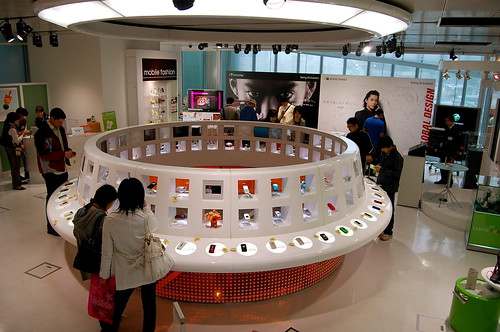
So, back to what I was going to share. Today I was frustrated and tired after being stuck in Warp Zone (which some like to call Meiji Dori), and instead of finding the store I wanted (Laforet), I wandered into a five-story, circular building with the same internal architecture as the the Guggenheim. I think I was drawn to it because there was a lot of stuff happening in there - computers, lights, flashy larger-than-life images of well-dressed models holding cool devices, etc.
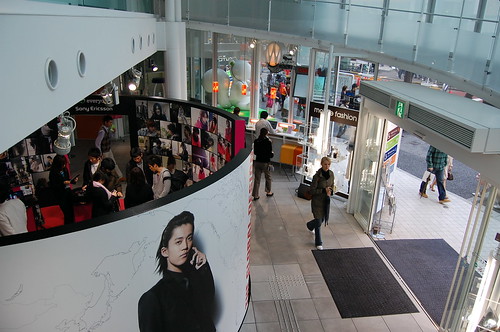
4 or 5 floors, Guggenheim-style.

The guy working the first floor was very proficient in English (and he liked to practice, I think), and he was telling me all about this structure. Apparently it is owned by KDDI, which is mobile carrier and ISP in Japan. It's called the KDDI Designing Studio, and each floor does something different. In order:

1. Live Lounge - free Internet on four computers (one of them ONLY runs Second Life, which was amusing) and a huge center-floor Sony Ericcson display

2. au Design Park - the newest concept models are displayed here (including the very rectangular and very flat flip phone styles I have seen on Gizmodo), space station-style:
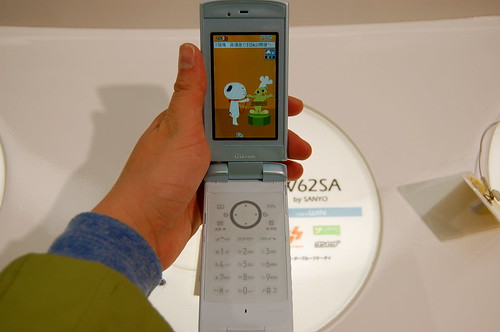
want.

Why can't the U.S. catch the hell up with the rest of the world?

KDDI Designing Studio

3. KDDI Portal Living - new experimental technology is demonstrated (you can try it out too); right now includes a broadcasting service and a Sony /au music collaboration (I think au is a handset manufacturer)

4. Lismo Forest - this was a surreal, storybook-like forest setting, featuring LISMO (an online music service run by KDDI)'s mascot:
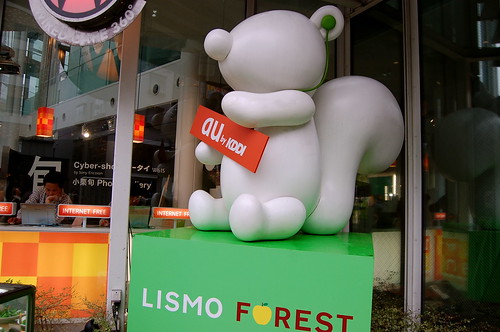
Lismo

5. Wired Café 360° - must have missed this one... the pamphlet I took calls it an "urban escape," while my English-speaking friend stressed that I could get a beer there.

This Designing Studio was awesome. Yes, we have all heard about "creating an experience for the consumer" a million times. Well, duh. I had quite the nice time walking through it and touching the shiny phones devices (also: on the walls going up the spiral was a nicely-designed and laid-out history of mobile handset design).

I'm sure that in the minds of people who live here and are familiar with these brands, they all live together. I am trying to think of a relevant U.S. example (help me out if you can think of one), but I'm pretty sure there is a competition problem – in addition to an infrastructure problem – in North America. Carriers are – from what I have seen – obsessed with taking over the user interface of their devices (among other things). I think I had an LG VX450 before Verizon started doing that, because I remember very pretty dandelion wallpaper with purple trim and very intuitive UI in 2004. Well, when I got a RAZR two years later (for very few months, please forgive me), the UI was terrible. And it was RED and I couldn't get it to NOT be red. Because of this, there were two separate components in my mind: Motorola (handset) and Verizon (carrier & user experience). Not "one, single, streamlined" mobile experience. This entire KDDI Designing Studio felt cohesive, and I mostly had no clue that there were at least four brands working together in this space until I did some research. I wonder when something similar can happen in the U.S. (if ever). I would love it.

(I would also love to hear thoughts on this, please share! I just kind of started typing without a real point or end opinion on how things can change.)

* If you want to read more about my trip (including photos), check out my Tumblr page. Oyasumi nasai (good night)!

08 April 2008

Color turning into sound turning into color

I was of course excited to get an e-mail from the lovely Dylan Trees with the subject "Synaesthese-tastic" last month. The article he pointed me towards was fascinating; it tells the story of an artist/musician whose life was changed by a cybernetics expert he met in art school. Cybernetics, Wikipedia says,
...is the interdisciplinary study of the structure of complex systems, especially communication processes, control mechanisms and feedback principles. Cybernetics is closely related to control theory and systems theory.
For this to start making sense: I should point out that the artist, Neil Harbisson, has achromatopsia – complete congenital colour blindness (he sees the entire world in black and white).

Upon a visit to Harbisson's art school, Adam Montandon (the cybernetics expert) heard about his condition and decided to work on helping Harbisson be able to paint in color (all of his work up to this time had been in black and white). He developed a machine called an Eyeborg that converts colors into sounds. When Eyeborg's mechanics are explained, it makes sense, but at first I had no clue how a device like this could even work. Well, different colors reflect light at different frequencies, right? This is how the thing looks:


When Harbison looks at a color through the lens, the sound frequency of the color is calculated and fed back to him as a specific noise that corresponds with that color's light reflection frequency. After a buffer period of learning which sound correspond to which color, Harbison is able to paint in the colors that the Eyeborg is "seeing." Pretty awesome, yeah?


He has an exhibit of city street scenes approaching in London; he's also working on the coolest-sounding project ever:
representing each capital city in Europe as a square made up of two triangles of different colours. In Monaco, it was azure and salmon pink; in Bratislava it was yellow and turquoise; and in Andorra it was dark green and fuchsia.
I would love to see that. Pretty awesome technology and concepts. One of the comments on this article presented a good idea to go along with it: "It would be very interesting to hear the sounds that he heard while viewing the individual paintings. Something the gallery should organise, perhaps." What if those ridiculous telephone-looking things that people walk around museums with actually played the sounds as one walked by each painting, as opposed to telling the story behind it (which could be reserved for the introductory plaque at the beginning of the exhibit)?

EDIT | Something amazing happened. Montandon (the creator of this amazing technology) commented on this entry, leaving a link to more information on his blog. Thanks Adam! I look forward to reading more.

24 April 2007

I love technology.

My favorite timeline of the day:

Kate [in Naked kitchen]: "Anybody know how Ben takes it?" - 4.06pm
Me: [Twittered the quote] "Twittered!" - 4.06pm
Noah: [text messaged me] "Re: your last twitter--ha!" - 4.08pm
Me: [text message response to Noah] "I love technology." - 4.09pm
Dino: [Twittered] "oh my johanna, what is going ON there?" - 4.10pm
Noah: [text message response to me] "Its great that I can be in san Francisco and still enjoy the deprecation of Ben" - 4.12pm

18 January 2007

economic dominoes


I never thought about how the advances in one industry could indirectly affect the success of a completely different one. In one of my Thrillist emails this morning, I learned about a spa in the city called Graceful Services that offers a new type of service. $60 buys you an hour of massages related to stresses that technology brings: a BlackBerry finger massage - which alleviates BlackBerry thumb - and face and neck massages that target other specific areas ("tech neck" and the facial muscles that are pushed up against mobile phones). At first I was rolling my eyes, but then realized that in a city like this, they might actually make a ton of money. Smart, and they seem to have thought of it first.
Related Posts Plugin for WordPress, Blogger...