Showing posts with label published. Show all posts

13 July 2012

Perceived Disconnection & The Three Versions Of Out-Of-Office

A little while ago, I was horrified to realize that I had not taken a proper, off-the-grid vacation in around three and a half years. So I did – I took a four-day weekend with Mister Cellar Door, and we drove to Montreal. On the way, I deleted my Inbox from my phone, turned on a minimal data package, and proceeded to eat poutine, drink absinthe, stumble through toddler-level French, and finally meet Julie after six years of being pen pals. The entire experience was awesome, and I wrote this little thing the night after I got back. It originally went out as one of our weekly newsletters at Undercurrent (sign up at the bottom of the post on our site if you like digital musings).

. . .

Sociology grad student Nathan Jurgenson recently spurred interesting debate with a post at The New Inquiry called “The IRL Fetish.” As the title suggests, Jurgenson approaches the verve with which people celebrate disconnecting, unplugging, and going offline. The romanticization of being offline – of trading MP3s for vinyl, email for letter writing, and wearing a weekend tech sabbatical as a badge of honor (and later tweeting about it) – has been a recurring topic as the tools for digital communication have accelerated and become more widespread.

The IRL Fetish puts a new perspective on things, though, and argues that there is no such thing as being either online or offline – the two are intrinsically intertwined. As The Verge wrote in their discussion of the piece:

…Offline interactions are precisely what drives the churn of information on networks like Facebook, and that the internet actually allows us to appreciate the real world in a way we would have taken for granted before. The next time you’re hiking up a mountain, relieved to be free from the constant chiming of email notifications? You couldn’t get that feeling without an email account.

These distinctions between online and offline, between between being plugged-in and being unplugged, have weighed on me somewhat as I prepared for vacation. Six months ago, I was introduced to three versions of being “out-of-office” at Undercurrent:

  1. You are out of the office, but still working – from home, a coffee shop, across an ocean, take your pick;
  2. You are out of the office/on vacation, but still “connected” – regularly checking and responding to emails;
  3. You are out of the office/on vacation, and completely off the grid.

Because we have no official vacation policy, we are encouraged to decide which version of out-of-office we want to be, and to plan accordingly – give enough notice, delegate responsibilities to teammates, notify clients, and set an appropriate auto-responder email.

Once upon a time, there were only two versions of being out-of-office – you were either working from home (or traveling to be with a client), or you were on vacation. And when you were on vacation, you were generally unreachable except via bat phone if something went seriously wrong. Being out-of-office and on vacation but still “online” is a more recent development – a hybrid option of these two states – and it is arguably the most tricky to navigate since the out-of-officer exists in a sort of limbo state, both actively thinking about work and not at the same time.

This limbo state can be experienced not only while on vacation, but during the weekend when days spent brunching with friends or visiting a museum will be punctuated by the buzz of an email (because someone will always be emailing on a Sunday). Having true “balance” of work and life these days is harder to achieve than ever, because more and more, “taking time off yet on email” seems to be the easiest mode to slip into – even if you are trying to enjoy option 3 and going “off the grid,” you will still be thinking about how full your Inbox is getting.

In the end, these three tiers of being out-of-office are functionally practical and reflective of the contemporary realities of doing business. Several studies have explored technology’s effects on the expectation of instant gratification, and managing those expectations is critical in preventing misunderstandings and generally keeping things moving while you’re away.

But setting your own personal expectations and acting accordingly in turn could mean the difference between rerouting an email while sitting on a hill, and taking in the full experience of watching a foreign city buzz from a spectacular view over a long weekend. Sure, we will not psychologically be able to be truly “offline” anymore. But we, for the well-being of everyone here, enthusiastically encourage its analog – deleting the Inbox from your phone from time to time and making the decision to return later.

17 January 2010

The Butterfly Effect

Sometimes life will give you signs, and it is good if you can see them, because they can show you the way and prepare you for what is to come. The most important signs are usually not labeled, so they are like secret signs. They occur in the physical world, but they map your inner landscape, and they are made just for you. Since they are secrets, you cannot read them directly — instead you must use feeling and intuition to uncover their meaning.

– Jonathan Harris, Jan 16, 2010*

A few months ago, Kevin from Given Collective contacted me about another project he was cooking up (he was behind both One City Left and DOCUMENT Magazine). His next idea was for an online, thematic version of DOCUMENT called Weeklies, and asked if I would consider contributing. At the time something pretty strange was happening around me, and I decided to write about it and call it The Butterfly Effect. Kevin graciously commissioned a Toronto-based illustrator to create a visual to go along with my piece. Awesome!

Screen shot 2010-01-18 at 9.59.33 AM

At the end of September, I read a crazy article in an in-flight magazine, of all places, about the migration paths of monarch butterflies. Every year they fly from Canada and the Northern US all the way down to the volcanic belt of Mexico and back, and for thousands of years this path was a mystery. Then in the 1970s, an American engineer and a kid who had never met each other figured it all out together. The engineer was traveling in Mexico, and had known about a Canadian entomologist who had been trying to figure out the monarchs’ paths by tagging butterflies before they left region each year. The engineer spoke to some locals, scaled some volcanoes, and after a long time of searching happened upon a tagged butterfly. He called the number on the tag, and was shocked when it wasn’t the entomologist on the other end, but a 12 year-old boy in Texas. The boy had been tagging butterflies as a hobby for some time, but had no idea he would one day play a huge part in figuring out one of the biggest mysteries ever.

Two or three weeks later, some research at work led me to the coolest example of biomimicry I have ever come across. Nano-engineers have been using butterfly wings as inspiration to build better security systems. The wings are made up of thousands of little scales, and there is one type of butterfly whose wings change color when they sense certain atmospheric changes. These engineers are trying to recreate the basic structures of the wing scales to improve the technology in public security sensors (potentially making us safer at concert venues, in the subway, at airports, etc.). I couldn’t stop talking about it for days.

Not soon after that, I turned around at work to see Clay putting a presentation together. The slide he was making was a single monarch butterfly on a dark background. When I asked him about it (having forgotten about both the migration and biomimicry cases), all he said was, “Butterflies are actually kind of awesome.” All of a sudden something clicked in my head, and we spent the next few minutes talking about it. He brought up the butterfly effect, which had slipped my mind until then: that something as slight as the flap of a butterfly wing can alter the atmosphere enough to drastically affect weather patterns in the future.

By the time I read a blog post that weekend announcing the opening of a massive butterfly exhibit at the American Museum of Natural History, I started feeling like there must be something going on here. I told Jack about it, and over the course of the next couple of weeks, butterfly imagery started popping up everywhere for him as well, the photographic evidence of which would turn up in my Inbox every day. I saw a blue morpho perched among piles of bones and shells in a window display on a cold and gray afternoon; I looked up from a pounding headache in the coffee shop to see a paper kite on a poster; I walked to the subway in the freezing rain to see the silhouette of wings on a hanging store sign; they were in a short story about nuclear holocaust; in the song title of a band I had never heard of who reached out to me online. Sure, this could be partially a case of perceptual vigilance, a type of selective perception that makes one more attuned to (and notice) the things they are looking for.

Refusing to believe that cognitive bias explained this entire thing, I read everything I could about butterflies. Spending some time on Wikipedia, I learned that throughout history butterflies have stood for both good and bad things, depending on the culture. Sometimes seeing one means a loved one is going to visit you, and other times it means that somebody is about to die. Sometimes you can expect good fortune if one lands on you, and other times you will have bad luck if you don’t kill the first one you see each year.

Reading a dream dictionary told me that butterflies often symbolize some kind of major transition. Remembering the fact that I had been through three major life changes in the second half of 2009 got me thinking about the subconscious. If the cryptic things that pop up in our dreams are actually manifestations of our conscious thoughts or stories that our lives are writing, why can’t these symbols be present in our waking life as well? Perhaps they are for everyone, but are so subtle that we don’t notice them at all or even know to look for them.

It’s clear that I haven’t figured this out yet or come to any sort of conclusion. In the meantime, butterflies have become a type of cognitive security blanket for me, every time I see one now, my mood soars. Maybe it’s my own way of telling myself that Things Are Pretty Great.

---

While I was thinking about all of this, I kept a small Flickr set documenting some of my (and a couple of Jack's) butterfly sightings. Check it out if you're so inclined. Otherwise: Thank you Kevin, thank you Devin for the illustration, and thank you *Jack for keeping the serendipity coming always! })i({

16 July 2009

DOCUMENT Magazine

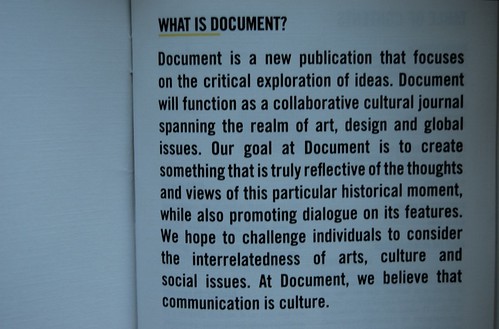
My friend Kevin (from the One City Left project) just released his next exciting project: a magazine called DOCUMENT. In his words:

DOCUMENT introduction

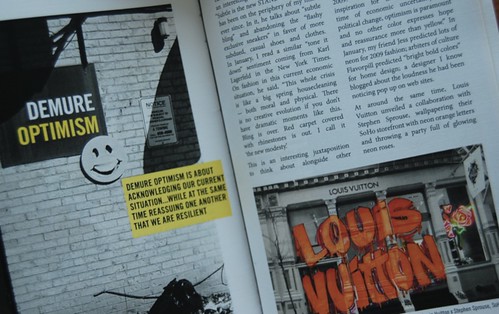
Kevin asked me if I might write something for the debut issue, and the phrase "cultural journal" made my ears perk all the way up. At the time I was thinking a lot about how the economy was manifesting itself in culture – especially here in New York – and I had just written a thing about it. I decided to adapt and tweak the thoughts for the magazine, including newer stuff that had surfaced since I had originally written it.

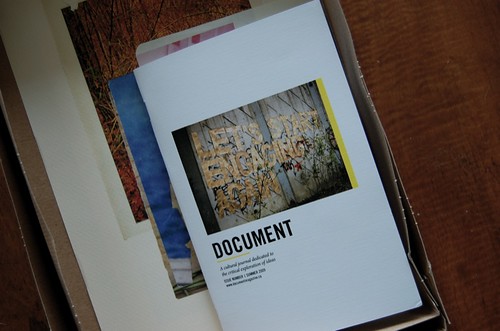
When Kevin pitched the idea to me, he mentioned that the written and artistic pieces would be packaged in a slightly nontraditional way: unbound and in a box, available at different locations around Toronto. I was very excited to finally receive a copy in the mail last week.

DOCUMENT packaging

Inside the box

My article in DOCUMENT

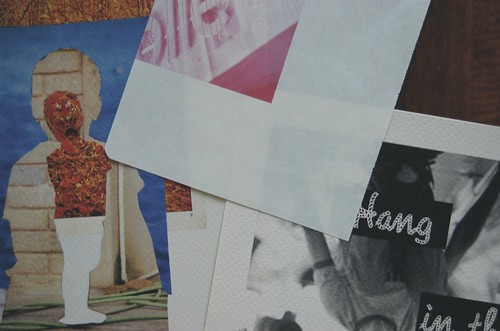
The whole project turned out pretty great! I loved Kevin's piece about an architect who takes her inspiration from animal behavior. There are some quotes and photography sprinkled throughout as well that are 100% inspiring.

Loose leaf artwork

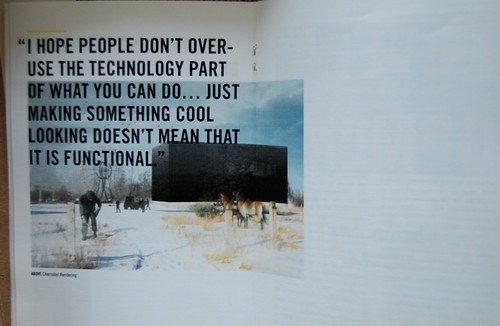
My favorite quote (and something I think a lot about):

Not chasing sparkles

Give DOCUMENT a visit – you can even download a PDF version. Stay tuned for Issue 2 :]

04 May 2009

New Next: It's what's on the inside that counts

I've been working on an internal communications project for a few months now, and have been therefore thinking about it a lot. It's so interesting to me now. I've gotten to play with some applications like Yammer and Jive SBS, and think about channels in a different way. Despite the newness, it still feels familiar. Companies are made of people, just like anything else, and I realized that communicating with people is just that: communicating with people, no matter the context. Sounds a bit obvious, but I didn't consciously think about it this way until I felt that "riding a bike" sense on the project.

Anyway, I wrote about internal culture & communications for the May New Next. For the past two months, the publishing schedule at the magazine was being shifted and sorted around*, so I think I actually wrote this back in February. Kind of explains the not-so-current nature of the examples, but the overall point is still relevant.

New Next: May 2009

Here's the text:

When brands and their agencies plan communications together, a component that largely gets overlooked is what to do within the company itself. Internal communications is a massive group of channels, and in the past couple of years it has become clear that what happens inside company walls is as important (if not more) as what is said outside.

A few brands have been on the right track and investing in their "insides" for a while now, and have earned respect in turn. Starbucks gives health care benefits, coffee and business education to all of its employees; Nokia's "Power of We" environmental initiative began as an internal credo and rallying cry; Google's "20 percent time" philosophy keeps employees inspired and allows them to enrich every part of their lives.

The most recent and impressive example of a brand that has done this is Honda, who recently relaunched their Power of Dreams Web site. Through a series of short documentaries, employees and friends of the company are interviewed to give candid thoughts and anecdotes.

Light bulb clusters

The series that launched first, Dream the Impossible, centers around the tenacity that Honda employees have in achieving seemingly impossible goals and being unafraid of failure. Engineers, designers and even Honda's then-president and CEO regale us with stories. They touch on engine failures, factory recalls, public apologies and taking risks without a safety net. Giving this type of bare-it-all peek behind Honda's curtain is admirable; how many CEOs publicly talk about encouraging their employees to fail as many times as it takes in order to make "fantastic advances in technology"? It feels honest and genuine, and not just a marketing gimmick. The videos also demonstrate the value that Honda places on community by showcasing anecdotes and opinions from employees at all levels within the company.

New videos will be uploaded every few months to give us a peek into Honda, and the minds that make the company tick. Together, the videos lead to an insightful understanding of the values and philosophies that fuel the company, and speak volumes more than a traditional ad campaign could.


The news about Takeo Fukui's stepping down actually broke a week after I sent the article to my editor, so I had to scramble to change the details. I was a bit sad, since his part in the failure video made the biggest impression on me. Hopefully the new President/CEO (Takanobu Ito) continues on with this philosophy.

* Amber also wrote an article that ran in the May issue. It's about the new platforms for tv-watching that are always popping up, and what they mean for content distributors, hardware manufacturers, cable companies, etc. It's really smart and insightful. Check it out: New Next: TV Channels the Internet on her blog. Both are x-posted to House of Naked.

04 September 2007

A slight love letter to New York.


The September New Next just came out. I very slightly edited this because they didn't capitalize Naked Communications or New Next in the first sentence. But other than that, here you go. We didn't get the issue in our office yet, otherwise I would have adorned this entry with a .pdf scan (fixed!). Oh also, I don't think I knew when I wrote this a couple of months ago that McCarren Pool parties were not going to be happening anymore :(

"It's been exactly one year since I moved to New York, started at Naked Communications and wrote my first New Next column. After some reflection, I realized that New York is actually the New Next — the most exciting place to be right now for this business that we're in. Not only is this city naturally bursting with cultural opportunities, but brands are also beginning to add to this culture in smarter and more strategically complete ways. There are so many different kinds of agencies forming here all the time that do a variety of fascinating things, ranging from digital strategy shops to design and innovation startups.

Ten years ago, the mass communications industry in New York was far from exciting. Global brands worked with monolithic agencies, nobody wanted to take risks and there seemed to be a predictable formula for all campaigns. The Madison Avenue giants that dominated the ad world were as corporate as banks, and clients themselves were conservative. So much has changed since then though, and now this industry matches New York as a city.

New York has always been anti-establishment — and about opportunities, taking risks and being unafraid of change. It could never be the capital of this great country because New York is not so much about historical tradition and preservation as it is about tearing things down, reinventing and starting over with the next exciting thing. For example, McCarren Park Pool in Brooklyn, built by the WPA during the Depression, was once one of the biggest swimming pools in the country. Closed for years, it's now used for a weekly summer indie rock "pool party." The High Line, a former elevated freight railroad in Chelsea, was abandoned and left to rust in 1980. By next summer, it will have been converted into a floating park for New Yorkers to enjoy.

People were always telling my class at the VCU Adcenter that we were coming into this business at the most exciting time in the history of advertising and media. We didn't understand what that meant until we got to jump in and live it. Whereas there were a small handful of general media channels in which to buy and place communications years ago, there are dozens today. From digital peer-to-peer to experiential out-of-home and SMS response, media channels have been fragmented and broken down enough to allow for virtually infinite ways of communicating with people. We can finally be more strategically creative about things.

For example, Nike Vintage Running didn't stop at its beautifully crafted and designed Web site — they had several of the shoe models displayed in a beat-up van right in front of the weekly party at McCarren Pool this summer.

It was so strategically placed and branded that partygoers had a hard time figuring out if it was a Nike-sponsored stunt or just a bunch of hippies trying to beat the heat in their van. Scholastic recently shut down an entire street in SoHo and converted it into "Harry Potter Place" in anticipation of the midnight release of the final volume. They brought in wizards, artifacts from the books and a giant countdown clock to entertain fans who had waited in line for hours to get the first copies.

This refreshing change in our industry is not going unnoticed, either. Global brands with billions of dollars in ad spend are pulling out static, one-way communications ideas and starting to take risks. Big agencies are re-evaluating and trying to reinvent themselves. Smaller agencies are growing because they were willing to take huge risks that are now paying off. And not just risks, but strategically smart ones.

The renaissance of the creative inspiration that was present in the early days has slowly been making its way back into our industry for a little while. Now it's in full swing. They were right — this is the most exciting time to be here, and I'm thankful for that. I'm able to watch and contribute to the energy that surrounds the thinking in our industry. We might not be the capital of the country here in New York City, but we are the capital of the creative and entrepreneurial spirit."

Written by Johanna Beyenbach, associate strategist, and curated by Paul Woolmington, Naked Communications.

Not sure how much I'll be updating in the next week, as I'm going to Brazil and Colombia for work-related things. I'll try though! xx
Related Posts Plugin for WordPress, Blogger...