30 December 2025
When the system lives in you
09 October 2012
What do you call yourself?
Snippets from a conversation John and I had yesterday. This a thing I've been thinking about lately – When is someone an artist? Writer? Musician? Actor? And why do only creative titles come to mind when typing these options out - because a trade is tangible, more easily tied to a product that you make a living making, and therefore less of a fuzzy concept?
John: When can someone legitimately say they "do art/music/acting" for a living? Because you know, like half of Brooklyn says that's what they do.
Johanna: I love that conversation. I was having it with Mr. T the other day…
John: What do you think?
Johanna: I am not sure, I want to talk about it more with people. Mr. T told me he'd call me a writer over a musician, even though I feel music ingrained in me, and am drawn to it more. He said it's because I write more frequently/regularly. When I asked Laura if she was a writer she said no, which shocked the hell out of me, because even though she's a transportation planner, writing is what.she.does. And has always done. And she's phenomenal at it - it's like speaking a foreign language fluently. And the other day, Aaron said he'd "definitely" call me an artist even though I don't consider my little projects "making art." It has totally depended on who I've spoken with.
John: Interesting. I think it's fine to consider yourself anything as a hobbyist. But when I ask someone what they do for a living and they give me an answer that doesn't involve paying their rent, I think less of them for a half-second.
Johanna: That's just interpreting your question wrong, to me. [To me], "for a living" means "how do you make money," and "what are you" is different. Sometimes it's the same.
John: I don't like it when people don't take pride in what they do. People should own their stuff.
Johanna: It's weird. I wouldn't call myself a photographer even though I take pictures all the time. Maybe because people don't seek me out for it (well, even when they did!). But people don't seek me out to make music either (nor has anybody even heard me play, really), and I would call myself a musician. So weird. I guess it's about self identity. Which you could say is a version of "owning their stuff."
John: Right, identity is so interesting and tricky. I'm all for creative self expression. But for real, people who front… it's like, first, it's bad that they think there is something about being a waitress that is inherently degrading, or shameful. That's F'd up. So right away I take issue with it.
Johanna: You mean, like, "there must be something else that you do" projection?
John: Well, aspiring to be something is wonderful. And having something that enables you to pursue that isn't shameful.
Johanna: I think people forget to think about it that way, or just don't/haven't gotten there yet.
John: Like, if I ask you "what do you do" and you say you're an artist, the next question i'm going to ask is what your medium is. And so on. Because I want to know about that.
Johanna: Do you think someone can call themselves an artist if they are describing how they see the world and how they interact with it? Like Sophie Calle or something? Sometimes she did installations but other times little social experiments and documented them.
John: Hmm, I haven't really thought about that. I think I would consider what they do sort of at the cross section of art and philosophy, if it's expressing a point of view.
Johanna: Interesting, I looked her up on Wikipedia to see how it would describe her: "Sophie Calle (born 1953) is a French writer, photographer, installation artist, and conceptual artist.[1] Calle's work is distinguished by its use of arbitrary sets of constraints, and evokes the French literary movement of the 1960s known as Oulipo."
The conversation went on and on, and slowly started unraveling because we got distracted by Hemingway cats. But, what do you guys think? Is it being paid for X thing that makes you X? Spending a lot of your time thinking about, immersing yourself, and making that thing even if it's privately/on the side? A way of looking at the world? The thing you do that makes you feel the most you, comfortable, and like you are home?
07 March 2012
Self-Interest And Collaborative Systems
Something else I wrote ended up on the Undercurrent blog today; this is something I've been working on at varying levels of intensity for months and months. I'll save the whole story for a bit later, so here it is: Self-Interest And Collaborative Systems.

I'm pasting the body below, so a little preview before you dive into one of the longer things I've written: Driving a car is a hassle for a lot of reasons – more and more cars for limited road capacity is one of the big ones. Congestion can lead to a lot of frustration, feelings of isolation (which is interesting since driving is a communal activity), and selfish behavior (cutting people off, not letting other cars merge into your lane, running red lights, rubbernecking at accidents, etc). I explore how different forms of digital in transportation can be used and combined with other things to lower selfish behavior and encourage drivers to be more collaborative on the road. Traffic is a system, after all, and one selfish move can throw ripples of inefficiency throughout the entire thing. Interested? Read on!
The increase in the number of cars on the road over the past few decades has created headaches for everyone, from drivers to transportation planners and law enforcement. Advances in digital technology over the past several years, however, have made driving in some places less of a pain. For instance, digital signage on busy roads can alert drivers of alternate routes if there is an accident up ahead. Automakers have been working on Adaptive Cruise Control technology to help regulate your car’s speed in relation to the ones around you. GPS systems now plan your routes based on real time traffic data pulled from sensors, news stations, and other drivers over time.
But a well connected network is only part of the solution to chronic traffic issues. For the past few years, drivers have been using tools that largely focus on making each individual user’s life easier, when we really need to be moving toward innovation designed to make the system as a whole more efficient. And for this to fully work, people must then learn to use new technologies in less self-interested (and more responsible) ways.
PEOPLE AREN’T PROGRAMMED TO COLLABORATE IN ANY UNORGANIZED SYSTEM
From driving to work to standing in line at the store, people don’t tend to think of themselves as part of a system when they make decisions. Everyone has an agenda when they’re on the road, and different individual factors – personal speed preferences, schedules, and desired destinations – contribute to the fact that drivers largely act in their own self-interest. Personal agendas are compounded by the fact that, despite being a communal activity, being stuck in traffic can feel very isolating – everyone is alone in their own vehicles. This lowers their perceived proximity to (and empathy for) each other even more. What results is a transit version of the tragedy of the commons, and yields the opposite of what drivers are working toward – each person reacts to the unpredictable and selfish behavior of others near them, which, like dominoes, sends ripples throughout the entire system that lead to more delays and frustration over time.
Why do systems that transport things other than people run more smoothly? With fiber optic networks, for example, light is sent down a tube at different frequencies, and (like traffic) all of these pulses of light travel at different speeds. The difference here is that each of these pulses never goes at any other speed. When you design a fiber optic network, you can account for all of these predetermined differences, and everything will keep running smoothly. Humans are not pulses of light sent down a fiber optic tube, and are not programmed to interact with each other in predetermined ways (or drive at a constant speed at all times). But small digital steps can be taken to help drivers understand their role in a larger system, and encourage them to collaborate a little more with each other to help everything flow better than it does now.
GROWING OUR SYSTEM AWARENESS
The first step in increasing collaboration between people in a system is to help them understand that they are, in fact, part of one. The Spectrum of System Awareness below broadly outlines the different levels of understanding that one is part of a bigger network of people. A person acting in completely self-interested ways is at the very center (A) – they are going to get to their destination no matter what, other drivers be damned.
The next ring (B) represents a broader awareness to include people in one’s immediate vicinity – in front of and behind them, and on either side. People at this level may exhibit some degree of collaboration with the drivers around them – they will switch lanes if they see the person behind them is driving faster, for instance.
Drivers at the third ring (C) have an awareness of everyone else on the road, and while they might not think expressly that they are “all in this together,” they do tend to think about their actions invariably affecting everyone else.
People at the fourth ring (D) are the holy grail for a truly collaborative human system – they have a full understanding of the fact that they are part of a system that necessitates collaboration between all participants to run well.
The farther out from the center someone is, the more they realize that the whole (traffic) is greater than the sum of its parts (each driver), and the higher their likelihood of understanding the benefits of collaboration. Rather than trying to get everyone on the road to level D at the same time (which is unrealistic), the goal for automakers, technology companies, software developers and transportation planners should be to keep all of the levels in mind when designing new technology and experiences – this will ensure that there are tools in place to broaden everyone’s degree of system awareness, organically. Real-time reporting and feedback loops are two of the most straightforward ways to give people more awareness of the system they are part of, their position in it, and the effects of their actions on it as it is changing.
Real-Time Reporting– Traffic reporting is not new, but it has traditionally happened on a mass, one-to-everyone scale within cities (usually via the radio). Since digital technology has afforded us the option to slice content to make it more relevant and personalized to us, we have some interesting opportunities to zoom in a little and put real-time information into a more personal context. Feedback Loops– You’ve probably heard of the kind of sensor technology that gives cars awareness of their immediate surroundings: cameras to help you parallel park better, or alert you when you’re getting too close to another car. A Volvo concept car debuted a new form of sensor at the Shanghai Motor Show last year: touch screen dashboard controls are embedded with eye tracking technology, and are only activated when you glance at the screen.What if sensors and behavioral tracking (think Prius’s consumption monitor) were combined? Layering both external and behavioral reporting together make understanding one’s place in the broader system much easier. Imagine a combination of sensors that tracks your driving behavior and its effects on the cars in your immediate vicinity. Or, combine real time traffic data with Volvo’s eye tracking technology, allowing you to know if you’re rubber necking too much at accident scenes, or constantly scanning your surroundings for a chance to pass everyone.
Either of these Frankensteined combinations of software and hardware can accumulate information about your own behavior, resulting in a report that tells you how much time you wasted by passing 4 cars and stalling at a traffic light over the course of your 20-mile trip. It could also tell you how much your actions delayed everyone else’s trip, and that 60% of people in your town drive better than you, on average. Reports on the effects of one’s driving behavior on the entire traffic system over time – framed in a personally-relevant context – would eventually give people a higher-level awareness of the ramifications of their actions.
FACILITATING COLLABORATION
How do we now encourage more collaborative behavior on the road? One way to do this is through a marriage of unconscious and conscious behavior change techniques.
Unconscious Collaboration
Unconscious collaboration results from a system using behavioral guides to influence how people act in relation to each other. The stoplights on highway on-ramps that seem to randomly alternate between red and green are called ramp meters, and they use real-time traffic information to regulate the vehicles entering a highway. Most drivers don’t realize that this guide changes based on current traffic conditions, or that they have been helping traffic as a whole flow better for nearly 50 years.
Conscious Collaboration
Getting people to consciously collaborate with each other is obviously trickier. Revisiting feedback loops: More than just receiving spoken turn-by-turn directions, drivers with certain GPS systems can now benefit from the integration of real-time traffic reports with detour features and rerouting suggestions. If the real-time tracking technology that makes ramp meters work connected with GPS systems, a driver’s Garmin could help them (and their fellow drivers) better navigate their surroundings smoothly by making contextual recommendations. Smarter, more-connected GPS systems could provide directions such as “Based on the traffic ahead of you, you will get to dinner 5 minutes faster if you stay in this lane and drive 5mph slower.”
Balanced Collaboration
Unconscious and conscious collaboration should not be looked at separately – a combination of smart behavioral guides and educational behavioral recommendations is the ideal.
Small digital steps can be taken to help drivers understand their role in a larger system, and encourage them to collaborate a little more with each other to help everything flow better than it does now.
Let’s combine our previous two examples together. Someone leaves their house to meet their friend for dinner, and punches the restaurant’s address into his dashboard (or mobile app) when he turns his car on. The car takes both traffic reports and information about other cars’ destinations into account when giving that evening’s driving directions. The car is also outfitted with proximity-based sensor technology – like Ford’s Adaptive Cruise Control – to regulate his speed when he’s actually on the road. The driver’s mind is operating on both the unconscious and conscious level – he realizes he is being directed along a route that makes his car “work with” all of the other drivers in traffic that day, but may not realize how much more efficient his regulated speed is actually making him and everyone else on the road. Over time, he might consciously make the decision to tone down his self-interested behavior and help the system run more efficiently.
14 September 2011
On muscle memory and piano playing
Now, this isn't necessarily a strange thing, because I've been playing for a long time and don't always have to pay conscious attention to every single note. But usually when I play Tiersen's work, I at least have to be partially thinking about what bit of the song comes next. On my upright, I didn't at all.
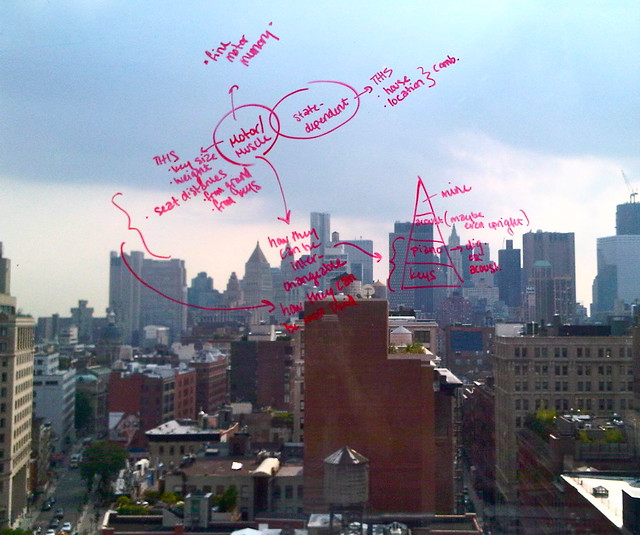
The reason I had such a hard time with this was: I didn't learn his music on my upright. I learned it on my digital piano. Shouldn't any song come more easily to me on the piano on which it was learned? This seemed like some sort of bonkers anti-state-dependent memory at work. I mulled the topic of muscle memory around in my head for a while, and finally dug into Wikipedia a little today to help with some rough thinking:

I realize that there is a lot of research already done around fine motor memory, the psychology of music performance, etc. But this is where my thinking-out-loud-for-fun brain took me.

As I said, my mind went to muscle memory first. At the base level, once someone has played the piano enough, they can play any piano. Quite literally "Like riding a bike." But something I recently read in Piano: The Making of a Steinway Concert Grand – that all pianos have their own personalities, tones, and feels – had me thinking about particulars. There's a reason why, even though I know how to ride a bike, I've always nearly broken my neck when attempting to ride bikes with bullhorn handlebars, yet felt like I could ride the ones with riser handlebars in my sleep. More than just muscle memory for the act of piano-playing, it was THIS piano (my upright) that I spent the most time with; THOSE keys, with their particular width, spacing and weight; THAT bench's distance from the ground and piano itself.
The other circle in that chart, state-dependent memory, represents that piano's environment. It's in the same place in my parents' house that it's always been in – off of the kitchen and under the Verona painting. Also, I'm much more used to the feel of the house I grew up in than I am in an apartment I've been renting for just 2 years (on top of that: my digital piano is in its 5th environment, or apartment, by this point).
So, muscle memory is how pianos can be played interchangeably. And the particulars of muscle memory with a side of state-dependent memory – that piano in that position of that house – is what made my playing the most fluid. Here's another way of looking at it:

I can play almost any instrument with a basic piano keyboard setup – from an accordion to a Schroder-style toy piano. But I'm not very good. I'm better with a proper piano – either acoustic or digital. By "proper," I mean all 88 keys that are weighted. Next comes any acoustic piano. As awesome as brands like Casio and KORG have gotten at simulating acoustic pianos with their digital versions (I have a Casio, and I love it), there is just no substitution for the feeling of hitting a key that subsequently makes a tiny hammer hit a string. And finally, my most familiar piano. This is why I think it doesn't matter at this point which piano I actually learned a song on: I'll always be better at it on that one upright.
For your supplementary fun:
Muscle memory (Wikipedia)
State-dependent learning (Wikipedia)
A page on sight-reading and memory (from The science & psychology of music performance)
My favorite Yann Tiersen-related video ever: Dave Thomas playing La Noyee on accordion
25 July 2011
Decoding The Shining
I was fascinated, watched the whole way through, and found myself then reading the text version of the analysis, which is really, really long (currently at 21 chapters). It attempts to parse all of the subliminal messages, themes and symbolism that he thinks run rampant in the movie. Covered are child molestation, alcoholism, secret societies, duality, genocide, animals, cartoons, and a bunch of others. Everything is tied together in a pretty engrossing package. There were definitely times when I thought the author was reaching for straws (he even says, "Before we move on to the next chapter, if you’re not familiar with a lot of the conspiracy theories discussed here then you may well be jumping to a 'Rob’s a bit of a nutter' conclusion" at one point, which made me laugh). At other times, though, the analysis was pretty hard to argue with, which led to a new respect and interest in Stanley Kubrick that I've not had before (I admittedly don't really pay attention to directors). There are ties drawn to Kubrick's other movies, to the making-of documentary of The Shining and its role in the movie's symbolism, and even the dynamics between him and the actors on set.
I guess it's no surprise that I liked reading this thing: what got me into Art History many years ago was a museum tour that took me through some of the hidden meanings and imagery in Salvador DalĂ's paintings. I really like the stories behind things – especially the ones that reveal stuff that is right in front of you and you don't consciously realize are there.

[source]
04 August 2009
Delightful error pages
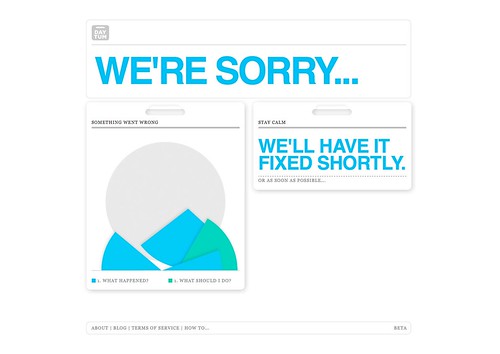
This one was four or so months ago on Daytum:

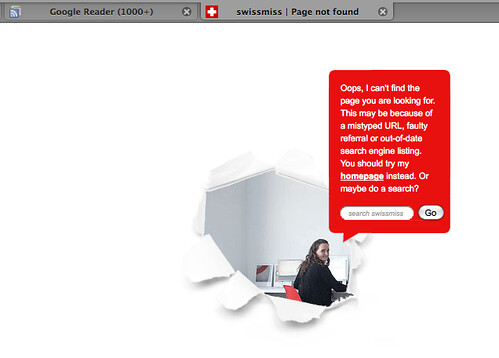
Here's the swissmiss one I got a few nights ago:

And this morning: Firefox.

[click all for bigger if you can't read the text]
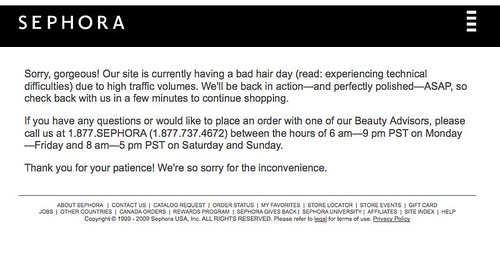
One would think error pages would = annoyed, I-just-want-to-use-the-site /find-what-I'm-looking-for thoughts, and they usually do... but these were disarmingly on-personality with each of the respective sites. Taking the time to put some effort into the little details and assuaging (hopefully infrequent) frustrations when things go wrong can go a long way, I guess*. I kind of want someone to do a psychological study on the effects of a disappointment framed in a charming way. Each of these times I smiled and forgot what I was even looking for or trying to do, and I was left with a positive feeling toward the site. An error page delighting someone? Pretty neat.
What are some of your favorites? Please share a screen shot or two if you can.
* One factor that matters though is obviously frequency: I have only seen each of these error pages only once. They can be as cute or clever as they want, but if they happen all the time (I'm looking at you, Fail Whale), they can somehow end up more maddening than a default error page. Over time, I began associating that whale with the Microsoft Office paper clip.
EDIT | The wonderful Amber just showed me this one she got at Sephora.com once:

Thanks Amber!
06 August 2008
The construct of loneliness & emotional bonds = ?
Let's say a guy (we'll call him Alex) goes on a business trip to a far away place and he misses his wife (let's call her Jenny). Alex emails Jenny a photo of himself waving to her from his hotel. Jenny responds with, "Great picture honey, but there's no substitute for the real thing, is there?""No substitute for the real thing." Is there?
What is it that lets someone form an emotional connection with someone /something else? Relatedly, in this case, what affects loneliness?
Physical proximity
So, Realdolls. You know what they are. And they are practically identical to the people they're modeled after. But with those, I bet money that their owners still feel lonely sometimes.
So is it the physical proximity of a real person (one who we know or feel a degree of closeness to) that influences loneliness (or lack thereof)?
Emotional proximity
Let's say Alex had not been physically near anybody he knew in a few weeks, yet he has not felt lonely when emailing with people from home who he knows (including Jenny). It's not physical proximity that lowers his loneliness in this case, but rather emotional proximity.
People vs. animals ; reciprocity
The hole with "physical or emotional proximity of a person" : it doesn't necessarily have to be a human-influenced thing. People form emotional attachments and bonds with their pets and sometimes don't feel lonely when they're around.
But some pets don't reciprocate attention or affection. Emotional bonds aren't as strong with fish as they can be with dogs, for example (I know there can be exceptions to this, but I'm writing in general terms here). So it is an issue of reciprocity, isn't it?
Cognitive processes
Surely reciprocity doesn't necessarily have to be present, as anybody who had a high school crush on the popular kid will know. What is it that people or animals possess that can cure loneliness or help an emotional bond form? Is it simply the presence of a certain level of cognitive processes; knowing that the possibility of reciprocity is always there?
Artificial intelligence
A.I. will get to the point where robots will engage in "advanced reciprocation" and be able to have complex conversations with people (maybe they already do in Japan). Yet, I just don't see substantial emotional bonds being formed with robots.
(Although it happened in that Spielberg movie.)
Maybe "cognitive processes" is too broad even still, since they will one day be mimicked very well. Is it about the neurological constructs that lead to that non-replicable thing that makes us human or animal? What is that thing?
I'm sure this has already been solved. I would love to hear everyone's opinion on this, get any leads to articles that talk about it, etc.
Photo credit: here.